

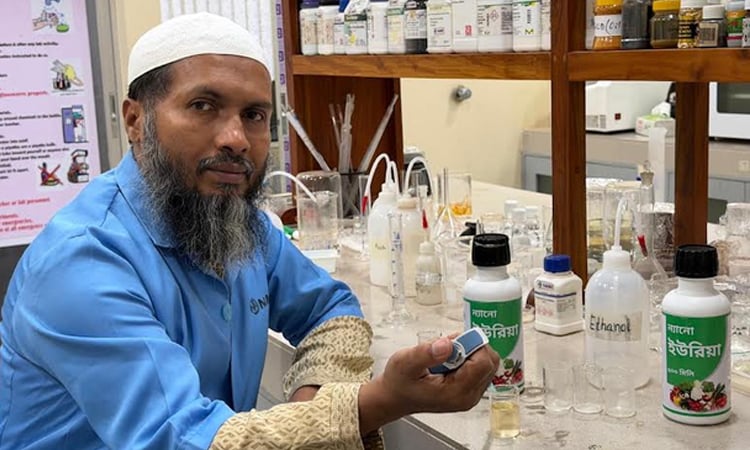
Agrivoice.net (BSS): After more than seven years of waiting, Professor Dr. Md. Javed Hossain Khan, a nanotechnology researcher at Jashore University of Science and Technology (JUST), has finally secured a patent for his indigenous nano urea technology, raising hopes of reducing fertilizer costs, cutting import dependence and promoting environmentally friendly agriculture in Bangladesh.
The breakthrough came following Prime Minister Tarique Rahman’s interest in the innovation, which had been developed in the university’s laboratory in 2018.
Dr. Javed said the prime minister’s personal interest helped move the patent process forward and that the government was also keen to bring the technology to farmers as quickly as possible.
However, obtaining the patent is only the beginning. The researcher now sees the development of a national policy, regulatory standards, field trials and commercial production facilities as crucial steps towards translating the laboratory achievement into a practical solution for the country’s farmers.
Dr. Javed’s journey into nano agriculture began during his studies in Japan, where he explored nanotechnology and its potential applications in farming. He became convinced that the technology could bring significant changes to agriculture, one of Bangladesh’s most important economic sectors.
After returning home, he decided to apply his knowledge to the country’s agricultural challenges. In 2013, he established the country’s first nano laboratory at JUST, which he said received ISO certification.
The laboratory became the birthplace of his nano urea innovation in 2018. He applied for a patent the following year, but the process dragged on despite repeated submissions, he said.
Conventional granular urea often fails to deliver all its nitrogen to crops. A significant portion may be lost through volatilisation, leaching and other processes, reducing fertilizer-use efficiency and contributing to air and water pollution.
Nano urea seeks to improve the delivery of nitrogen to plants, allowing crops to absorb nutrients more efficiently and potentially reducing the amount of fertilizer required.
According to Dr. Javed, the technology could lower farmers’ production costs while reducing environmental damage associated with conventional fertilizer use.
The potential economic implications are considerable. Bangladesh imports urea fertilizer worth around Taka 32,000 crore annually, according to the researcher, while the government provides substantial subsidies to keep fertilizer affordable for farmers.
If the locally developed technology can substantially reduce conventional urea requirements, it could help ease pressure on foreign exchange reserves, lower public expenditure on fertilizer subsidies and reduce dependence on imported agricultural inputs.
Dr. Javed said he had two long discussions with Prime Minister Tarique Rahman after the current government assumed the office. He also had an opportunity to showcase nano urea at the Governance Innovation Unit stall of the Prime Minister’s Office during this year’s Bangladesh Innovation Fair. The presentation brought the innovation to the prime minister’s attention and helped advance the patent process, he said.
“The prime minister already knew about nano urea. He said it works well at a very low cost and assured us that efforts would be made to bring it to the market and deliver it to farmers as soon as possible,” Dr. Javed said.
Dr. Javed said Bangladesh still lacks a comprehensive national policy on nano agriculture, leaving uncertainty over how nano fertilizers should be registered, tested, approved and brought to market. Without a clear regulatory framework, he said, large-scale production and commercial distribution of nano urea would remain difficult.
He called for a national nano-agriculture policy involving experts from the ministries responsible for agriculture, science and technology, and industry, alongside universities and relevant research institutions.
He also proposed a separate registration and standards system for nano fertilizers to assess product quality, safety and environmental impacts.
Before nationwide adoption, he recommended multi-season field trials across different agro-ecological zones, covering major crops such as rice, wheat, maize and vegetables. The Bangladesh Agricultural Research Institute and the Department of Agricultural Extension could play important roles in conducting and evaluating these trials.
Training for farmers and field-level agricultural workers would also be essential to ensure that the fertilizer is applied at appropriate rates and in accordance with safety guidelines.
JUST Vice-Chancellor Professor Dr. Iarul Kabir expressed satisfaction over the patent award, describing it as a source of pride for the university and the nation.
“The patent for nano urea, the result of the long dedication and research of Professor Dr. Md. Javed Hossain Khan of our Chemical Engineering Department, is a matter of pride for the entire JUST community and the nation,” he said. He also expressed hope that the innovation would contribute to saving foreign exchange and reducing Bangladesh’s dependence on imported urea.
For Dr. Javed, the patent is not merely a personal achievement but the culmination of years of research aimed at addressing a national challenge. He said the technology had received support from many people and should be regarded as a collective achievement for Bangladesh.
The real measure of its success, however, will be whether it can move beyond the laboratory and deliver measurable benefits to farmers. That will depend on rigorous field validation, clear regulatory standards, reliable production, affordability and an effective distribution system.
With the patent secured and the government’s interest emerging as a potential catalyst, Bangladesh now faces the task of turning a homegrown scientific innovation into a practical agricultural technology. “Only by building a modern Bangladesh through modern agriculture can the country take a leading position,” Dr. Javed said.