

Agrivoice.net (Sukanta Halder, the daily star):Farmers sell cauliflower, radishes and other vegetables to wholesalers at Bargachhi market beside Bargachhi Union Parishad in Paba upazila of Rajshahi earlier this month. PHOTO: Azahar Uddin Bangladesh’s fresh vegetable export earnings fell nearly 7 percent year-on-year in the July-September quarter of the current fiscal year as higher airfreight costs and food-safety concerns squeezed exporters.
Exporters fear that the situation could worsen in the current October-December quarter as flight disruptions involving Saudi Arabia, a major destination, threaten to further complicate the movement of perishable produce. Following a series of reported Houthi attacks in early October, restrictions at the Saudi Arabian airports have affected 134 flights involving Bangladesh, according to the latest figures from the Civil Aviation Authority of Bangladesh (CAAB).
Bangladesh earned $24.01 million from vegetable exports in the first three months of FY2026-27, down from $25.79 million in the same period a year earlier, according to data from the Export Promotion Bureau (EPB). Exporters said higher freight charges, flight disruptions, excessive pesticide residues in produce and inadequate cooling facilities at airports were making it harder for Bangladeshi vegetables to compete in overseas markets.
Chowdhury Anower, organising secretary of the Bangladesh Fruits, Vegetables and Allied Products Exporters’ Association, said Bangladesh’s vegetable exports primarily went to Saudi Arabia and other Middle Eastern countries, as well as Europe. He said conflicts in the Middle East had disrupted shipments, leaving exporters struggling to divert produce to alternative destinations. Unpredictable airfreight rates, rising labour costs and higher carton prices were also putting pressure on exporters.
Airfreight spot rates from South Asia to the Middle East remained 91 percent above their late-February levels in the week of September 21-27, according to freight intelligence firm Xeneta.
In its October 1 market update, Xeneta said global air cargo spot rates averaged $3.10 per kilogram in September, up 27 percent year-on-year and 2 percent from August. Demand growth outpaced capacity expansion, while higher fuel costs added to pressure on rates.
Anower said freight rates in Bangladesh were higher than those in neighbouring countries, making it difficult for local exporters to compete in international markets, particularly in Europe and the Middle East. Kawser Ahmed Rubel, chief executive officer of vegetable exporter Global Trade Link, also identified higher airfreight costs, excessive pesticide residues and inadequate cooling facilities at the airport as major obstacles to vegetable exports.
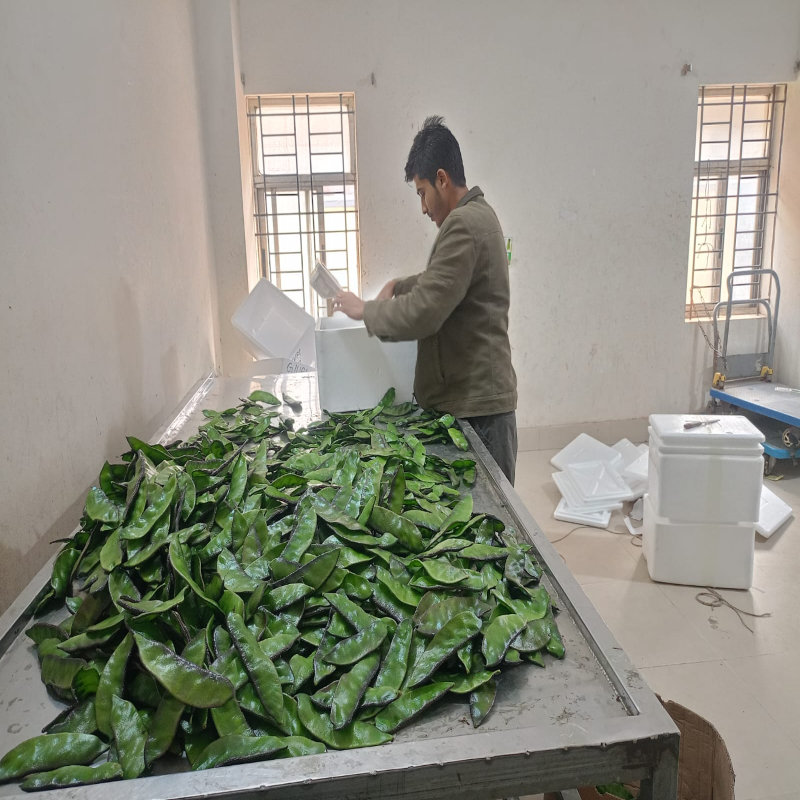
Airfreight rates had risen to more than Tk 550 per kg from around Tk 490 to Tk 500 last year, he said. The Daily Star could not independently verify the figures. Rubel added that pesticide residues detected in exported vegetables had led to restrictions on country beans and Zara lemons in European markets, affecting export opportunities.
EU regulations now require enhanced border checks on certain Bangladeshi vegetables because of pesticide-residue concerns. The European Commission, under a new regulation issued in June, requires identity and physical checks on 30 percent of consignments of “seem beans” and “helmet beans” from Bangladesh and 20 percent of Zara lemon consignments because of pesticide-residue concerns.
Rubel also pointed to a lack of cooling chambers at the airport, saying perishable cargo often remained at ambient temperatures for three to four hours after security screening before being loaded onto aircraft, potentially compromising product quality. Mobasserur Rahman, proprietor of BK Trade International, said high airfreight costs were the primary reason for the decline in vegetable exports.
Freight rates to Canada had risen to Tk 750 to Tk 800 per kg from Tk 300 to Tk 350 last year, while rates to London had increased to more than Tk 750 from Tk 250, he said. The Daily Star could not independently verify the figures. Bangladesh produces more than 15 million tonnes of vegetables annually but exports less than 0.3 percent of that volume, according to a recent report.